Candy Bars
© 2010 - 2026 by MrRinkevich.com
Served on
Throughout the Halloween season
Country of Origin
United States - 1950s
Recipe
Key Points / Halloween Connection
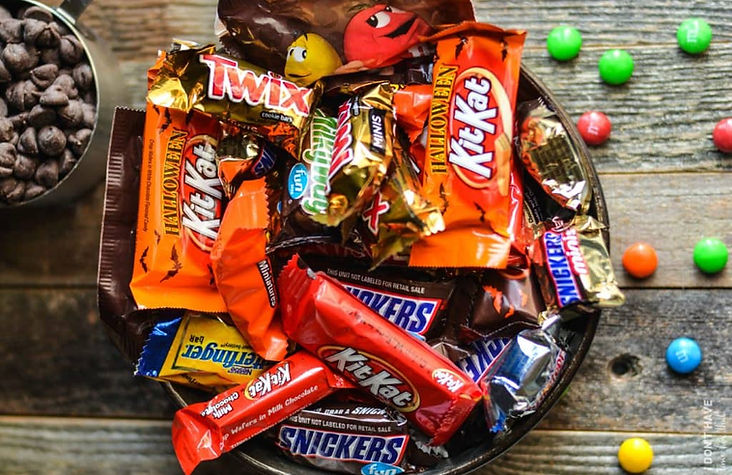
- Miniature individually wrapped mass produced candy bars became widely popular after World War II due to a massive marketing push and their convenience and affordability
Rink Fact: Due to recent studies on the negative affects of food additives there is a growing movement away from mass market candies and towards additive free candy as used in European Halloween celebrations
Brief Bio
Halloween candy history shows an evolution from ancient food offerings to the trick-or-treating of the 1900s with homemade treats, finally transitioning to the modern prevalence of individually packaged, mass-produced chocolate candies after World War II, driven by candy companies marketing them as convenient and ideal for trick-or-treaters. The affordability of chocolate, thanks to mass production by companies like Hershey's, and the practical advantages of small, wrapped sweets made them the preferred choice for Halloween by the 1970s.
Halloween originated with the Celtic festival of Samhain, where food offerings, including sweets, were made to spirits. By the Middle Ages, the British custom of "souling" involved children going door-to-door, offering prayers for the dead in exchange for "soul cakes".
In the U.S., trick-or-treating began in the early to mid-20th century, with children initially receiving homemade items like cookies, fruit, or nuts. Post-WWII Shift: After World War II, the U.S. economy saw a significant shift, leading to the mass production of candy.
Candy companies recognized the commercial potential of Halloween and began promoting small, individually wrapped candies as the perfect treat. Hershey's mass production made chocolate more affordable, and chocolate candy, along with other mass-produced sweets like M&M's and Kit Kat bars, quickly became popular.
Candy companies actively marketed their products for Halloween, and by the 1970s, chocolate became the dominant and quintessential Halloween treat. Individually wrapped candies were convenient to store, share, and distribute, making them ideal for trick-or-treaters.
Today, while mass-produced candies remain popular, there's also a growing demand for premium, artisanal chocolates and confection


Halloween Mythology